Effective today, Moldova has become the 40th member state of the European Patent Convention (EPC). In practice, this means that it is no longer necessary to extend protection to Moldova via payment of a separate EPO official fee. Instead, Moldova will be designated automatically, along with the other 39 member states of the EPC, upon payment of a single designation fee, integrating Moldova more deeply into the European patent system.
Moldova joins the European Patent Convention
By Nick Davies, Chartered and European Patent Attorney on


Wynne-Jones IP Launches New AI-assisted, Fixed Fee and Low-Cost UK Patent Application Service
An AI-assisted, low-cost, fixed fee UK patent application service, delivered under the supervision of qualified and experienced patent attorneys
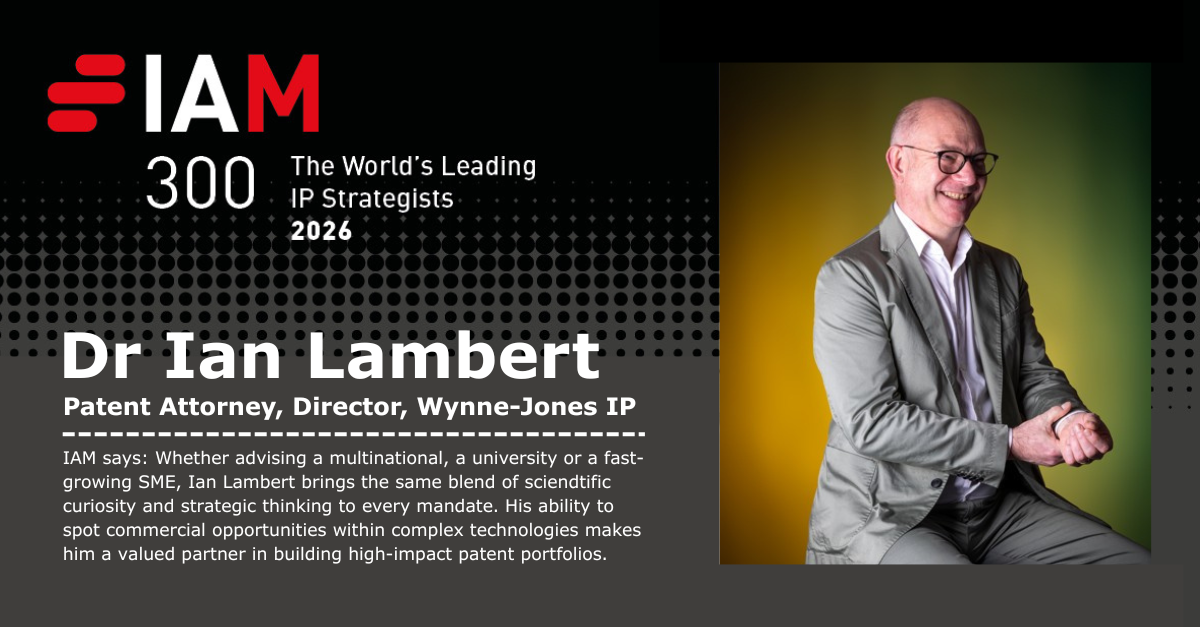
Dr Ian Lambert Ranked as Global Leader in IP Strategy
IAM Strategy 300 said, ”Whether advising a multinational, a university or a fast-growing SME, Ian Lambert brings the same blend of scientific curiosity and strategic thinking to every mandate. His ability to spot commercial opportunities within complex technologies makes him a valued partner in building high-impact patent portfolios.”

Curiouser and Curiouser - Final Thoughts and Impacts
Last year, the EPO’s Enlarged Board of Appeal (EBA) completely overturned the general approach that the EPO had taken for decades in interpreting patent claims. Instead of insisting that the claims must be inherently clear and interpreted without reference to the description, in decision G1/24 the EBA decided that the description and drawings must always be ‘consulted’ to interpret the claims- and certainly when assessing patentability. Unsurprisingly, significant uncertainty remains as to how G 1/24 is to be applied in practice. That uncertainty has already led to a further referral, G 1/26, which seeks clarification on a number of important issues arising from the decision.
In this article, we examine the questions referred to in G1/26. We also consider the potential potential consequences of the EBA’s answers for different parties.

Product-by-Process Claims: A Global Perspective
Product-by-process claims are patent claims in which a product is defined, at least partly, in terms of the process used to create it. From a patent drafting and a patent enforcement perspective, this can be very appealing. However, different countries have distinctly different views on product-by-process claims.

Jersey to Become a Separate Madrid System Designation
From 1 August 2026, Jersey will become an independent designation under the Madrid System, introducing an important change for brand owners seeking international trade mark protection.
Wynne-Jones IP recognised as a Leading Patent Law Firm in Europe
Wynne-Jones IP has once again been recognised by the Financial Times as one of Europe’s Leading Patent Law Firms, reinforcing the firm's reputation for delivering high-quality intellectual property services across a broad range of technologies and industries.

Aligning patent intelligence with new product development
In many industrial businesses, intellectual property is still treated as a late-stage consideration, addressed once R&D is complete. Leading innovators take a different approach. They integrate IP analytics throughout the new product development (NPD) lifecycle to guide technical decisions, manage risk and support commercial growth.
This article outlines how core IP analytics activities support each stage of the NPD process, and why it has become an increasingly important part of modern innovation strategy.

Exceptional Trade Mark Services for Our Digital Platform
"Working with Wynne-Jones IP has been an outstanding experience. Their combination of legal expertise, clear communication, and genuine support made what could have been a daunting process completely manageable for our startup."